


Regional Workshop to Advance Best Management Practices Scenarios in Egypt and Sudan
- Dec 4, 2025
- 3 min read
Updated: Dec 17, 2025
Continuing its commitment to regional engagement and evidence-based validation, the Climate Smart Water Management and Sustainable Development for Food and Agriculture in East Africa (WATDEV) project, funded by the European Union through the DeSIRA Initiative, held a Regional Workshop on 1st December 2025 at SEKEM Farm in Belbies, Egypt. The event was jointly organised by the local partner, Heliopolis University (HU) in collaboration with ASARECA, CIHEAM-Bari, and in the presence of AICS Cairo.

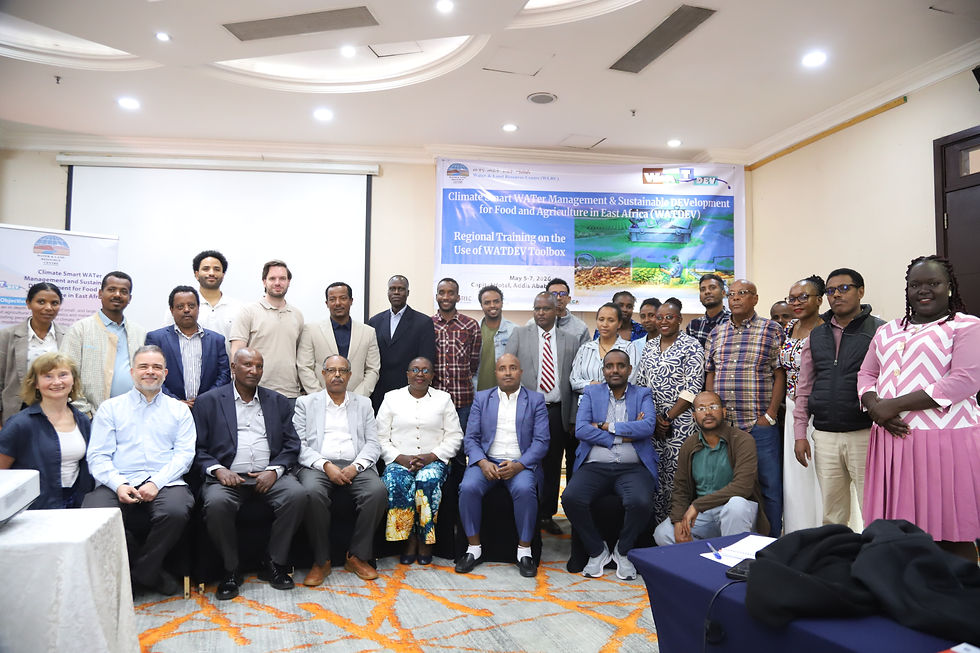
Approximately 50 participants attended the workshop, including researchers, decision-makers, government officials, water experts, local stakeholders and the project consortium. Together they engaged in in-depth discussions to refine and validate the Best Management Practices (BMPs) scenarios selected in Egypt and Sudan, and to develop implementation pathways aligned with local needs, constraints, and priorities.
Despite the critical situation in their country, the WRC team continues to actively contribute to WATDEV. During the workshop, they fully participated in discussions, shared insights from the Sudanese context, and collaborated to validate the BMPs scenarios selected in Sudan.
The Regional Workshop focused on participatory validation of the BMPs intervention scenarios at the basin level in Egypt and in Sudan. It opened with welcoming remarks from Prof. Wael Khairy, Heliopolis University, who emphasized the strong collaborative spirit that drives WATDEV. This was followed by Mr. Moses Odeke, Interim head of Programme at ASARECA, who highlighted the workshop as a pivotal moment in the WATDEV implementation towards advancing sustainable water management solutions. Dr. Gaetano Ladisa, WATDEV Project Manager at CIHEAM-Bari, further underscored how integrated management of water, soil, and crops, aligned with territorial and socio-economic contexts, is essential for sustainable resource use. He also highlighted WATDEV’s multi-actor, multi-scale participatory approach, where the scientific modelling and local knowledge develop together practical, scalable, and climate-resilient solutions.
Following these remarks, participants were introduced to the WATDEV project progress through a presentation by Ms. Concetta Bianco, WATDEV Project Coordinator at AICS Cairo. She showcased the recent achievements and outlined the upcoming implementation steps, reinforcing the value of multi-country collaboration in generating shared climate-smart water management solutions.
To ensure a common understanding of how stakeholder insights have informed the modelling work, Dr. Jantiene Baartman from ISRIC explained the methodology used to simulate BMP scenarios at the basin level. She detailed how data from previous field engagements was translated into modelling inputs and described the assumptions underpinning the scenario simulations.
A key highlight of the workshop was a detailed presentation of the simulated BMPs scenarios, delivered by PhD. student Samar Gomaa from ISRIC. She walked participants through each of the three simulated BMP in Egypt, manuring, intercropping, and Water Users’ Association (WUA), explaining the benefit of each BMP. The key achievements her presentation illustrated were how WUA model can significantly reduce irrigation water use; how manuring can enhance soil fertility and boost overall production; and how intercropping optimizes land use by combining different crops and trees for higher-quality outputs. This was followed with an interactive Q&A session allowing participants to actively engage to clarify modelling assumptions and discuss expected impacts of each scenario.


The presentation of the BMP scenarios in Sudan was shared by the PhD. student Mohamed Barsi, from ISRIC, in a preliminary online meeting held with the Sudanese partner WRC, ISRIC, CIHEAM Bari and ASARECA and which aimed at providing the Sudanese partner with the needed information to participate in this Regional Workshop in Egypt.
Participants were later divided into groups to deeply discuss and assess the proposed scenarios, facilitated by the modelling team members and Heliopolis University. This interactive session enabled stakeholders to assess scenario feasibility, identify enabling factors, implementation challenges and highlight opportunities for scenario refinement.
After the conclusion of the collective discussion on the validation of BMPs scenarios, Ms. Silvia Lecci from CIHEAM Bari led a survey on water management policy improvements. The survey aimed to capture stakeholders’ views on how WATDEV modelling toolbox could directly or indirectly support better policy and governance frameworks for agricultural water management in Egypt and Sudan.
The workshop concluded with a comprehensive synthesis session summarizing main insights, recommendations and scenario refinements gathered from the participatory discussions. Participants were also presented with a clear roadmap showcasing how their contributions will be incorporated into the next round of basin-level simulations under the WATDEV framework.
In essence, the Regional Workshop in Egypt marked a significant advancement for the WATDEV project. The integration of modelling and active stakeholder engagement ensured that the BMP scenarios developed are both scientifically sound and firmly rooted in local realities and institutional contexts. This collaborative approach enhances the strength of the WATDEV modelling toolbox and contributes to the development of more resilient, sustainable, and context-appropriate agricultural water management strategies across Eastern Africa.


Comments