


The training course on smart platforms for plant phenotyping concluded in Southern Italy
- Jan 26
- 3 min read
The Training of Trainers and Capacity Building Course on “Smart Platforms for Plant Phenotyping and Precision Agriculture: Tools, Practices, and Analytics” was successfully held in southern Italy from 21-23 January 2026. Organized by the Institute for Sustainable Plant Protection of the National Research Council of Italy (CNR‑IPSP) together with CIHEAM Bari and within the framework of WATDEV project, the course aimed at strengthening regional capacities in sustainable water management and climate‑resilient agriculture among researchers, PhD students, technologists, and professionals mainly from Egypt, Ethiopia, Kenya, Sudan and Italy, with international attendees joining remotely.
The course started with an opening session featuring welcome remarks by the Research Director of CNR‑IPSP, the Director of CNR‑DISBA, the WATDEV Coordinator at CIHEAM Bari, and the Directors of CNR-IPSP and ALSIA.
The course was structured into three intensive complementary modules devoted to advanced technologies for crop performance monitoring and optimization, with a strong focus on water efficiency and precision agriculture. All modules combined theoretical lectures with hands-on experience and demonstrations, fostering high-quality knowledge transfer and promoting the adoption of Best Management Practices (BMPs) within diverse local contexts.
During the first module, participants were introduced to high-capacity research platforms, including digital infrastructures for field-based and controlled-environment phenotyping, data management in accordance with FAIR principles, as well as artificial intelligence tools to support data analysis and decision-making in agriculture.
While the second module focused on field instrumentation and data collection, featuring practical demonstrations of portable sensors and instruments for the validation of remote and proximal sensing data. Through guided demonstrations, participants practiced image processing techniques and the use of vegetation indices for crop monitoring and water resource assessment.


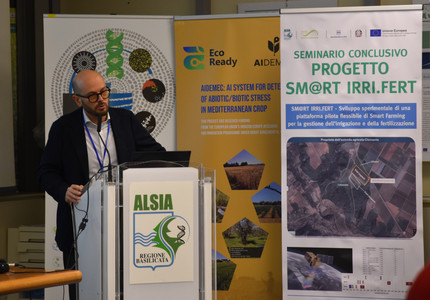
The third module addressed statistical analysis, predictive modelling, and the reuse of treated wastewater for irrigation. It included the application of statistical methods and machine-learning approaches to phenotyping and precision agriculture, alongside operational demonstrations illustrating safe and efficient strategies for wastewater reuse. This module additionally welcomed a delegation from Palestine and Morocco, hosted by the University of Basilicata, further enriching the exchange of knowledge and experiences.
Throughout all modules, training activities encouraged active interaction, problem‑solving, and the sharing of context-specific experiences.
To maximize long-term impact, the course adopted a Training of Trainers (ToT) approach, encouraging participants to disseminate the skills and knowledge acquired within their institutions and local communities, thereby accelerating the dissemination of innovation and sustainable water‑management solutions. At the end of the course, participants received certificates of attendance, recognizing their successful completion of the training.
The first two days of the training were held at the Metaponto site in Bernalda (MT) of the Lucanian Agency for Development and Innovation in Agriculture, while the final day was hosted at the Municipality of Ferrandina, focusing on innovative solutions and technologies aimed at enhancing the efficiency of agricultural water management.
As part of the third Module, participants visited the secondary wastewater treatment plant of Ferrandina, which hosts two demonstrator units for irrigation-oriented wastewater recycling. The visit provided a concrete example of how treated urban wastewater can be safely reused in agriculture, contributing to water savings and climate adaptation.


The course concluded with a round table discussion dedicated to the Mattei Plan for Africa, a strategic Italian Government initiative launched in January 2024 to foster cooperation with African nations. Moderated by Dr. Mauro Centritto, the session included interventions from policymakers and representatives of CNR and the University of Basilicata. The discussion served as a science‑policy interface, highlighting opportunities for further collaboration in research infrastructures and scientific training.
Both the technical visit and the round table fostered interactive dialogue among participants, reinforcing WATDEV’s commitment to innovation, scientific cooperation, food security, and climate resilience in agricultural systems across East Africa and Egypt.
WATDEV is funded under the DeSIRA Programme of the European Union and coordinated by the Italian Agency for Development Cooperation (AICS) in collaboration with CIHEAM Bari. CNR‑IPSP collaborates as a project partner alongside universities and research institutions from Europe and Africa. Through advanced research, modelling, technological innovation, and capacity building, the project works to improve the efficiency of agricultural water management and support the uptake of innovative climate-smart solutions by local institutions, technical professionals and rural communities.


Comments