


Regional Workshop in Ethiopia to discuss the agricultural best practices scenarios
- Dec 6, 2025
- 2 min read
Updated: Dec 19, 2025
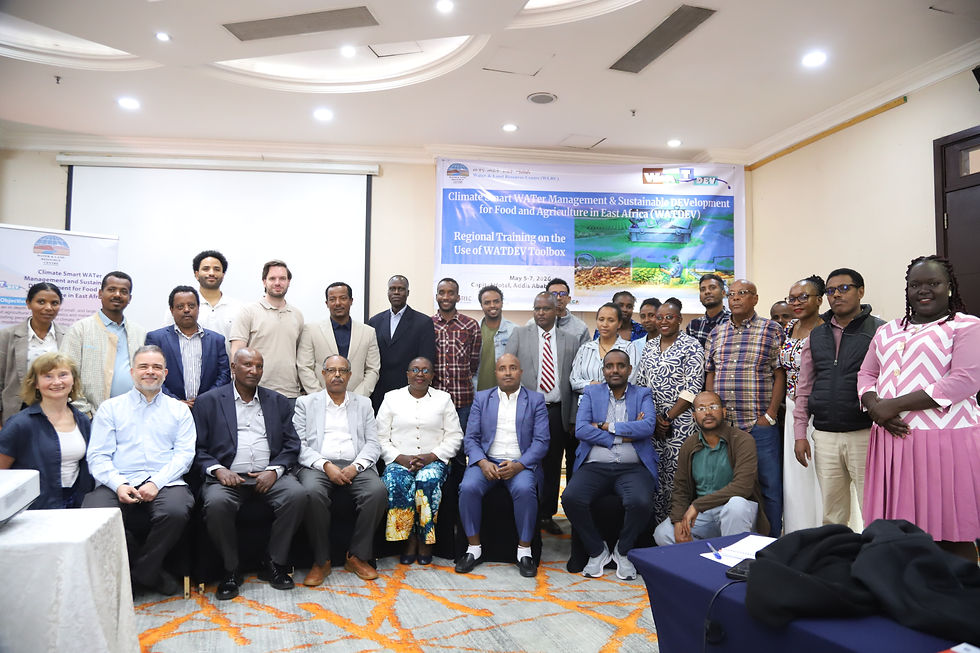
Following the successful workshops held in Kenya and Egypt, the Climate Smart Water Management and Sustainable Development for Food and Agriculture in East Africa (WATDEV) project continued its participatory journey with a Regional Workshop, held on 4th December 2025, at Swiss Inn Nexus Hotel, in Addis Ababa, Ethiopia. Organised by the local partner Water & Land Resource Centre (WLRC), in collaboration with ASARECA, CIHEAM-Bari, and in the presence of AICS Cairo, the workshop brought together researchers, decision-makers, government officials, water experts, local stakeholders to collaboratively validate the Best Management Practices (BMPs) scenarios ensuring its coherent with the local priorities and respond to real needs on the ground.

WLRC Director General, Dr Gete Zeleke, and Mr Elias Awol, CEO, Small Scale Irrigation Development, Ministry of Agriculture, followed by remarks from Dr. Gaetano Ladisa, WATDEV Project Manager at CIHEAM-Bari. He emphasized the importance WATDEV’s multi-scale participatory approach, where the scientific modelling and local knowledge converge to co-develop practical, scalable, and climate-resilient solutions.
Ms. Concetta Bianco, WATDEV Project Coordinator at AICS Cairo, presented the state-of-the-art of WATDEV project, highlighting achievements, milestones and the upcoming implementation steps. Her presentation provided the participants with a shared understanding of the WATDEV’s status. This was complemented by Mr. Moses Odeke from ASARECA, which outlined the Meeting’s main objectives, methodologies and expected results.
Dr. Jantiene Baartman, from ISRIC team, introduced the methodology used to simulate the BMPs/scenarios at basin level in Ethiopia. She explained how stakeholders’ inputs collected during the previous feasibility studies were integrated into the modelling process.
The PhD. student, Mulugeta Melese, from ISRIC presented the findings from the simulated BMPs intervention scenarios, focusing on the three selected BMPs in Ethiopia; agroforestry, composting, and the strengthening of Water Users Associations (WUA). Dr. Luuk Fleskens, from ISRC, outlined the post-processing outcomes on the simulated BMPs from a socio-economic point of view.
Participants, having gained a common understanding of the simulated BMPs, were divided into working groups to discuss the proposed BMPs in depth. This session enabled stakeholders to assess the feasibility of each scenario, identify enabling factors, potential challenges and highlight opportunities for refinement and improvement.


After the group discussion, the CIHEAM Bari team conducted a survey on water management policy improvements. This survey aimed to collect the stakeholder’s perspective on how WATDEV modelling toolbox can contribute to stronger policy and governance frameworks for agricultural water management at the local level.
The workshop concluded with a comprehensive synthesis session summarizing main insights, recommendations and refinements gathered from the discussions. This final exchange ensured that the proposed BMPs scenarios are closely aligned with real field needs and local priorities.
By engaging stakeholders at every stage, the EU funded WATDEV project under the DeSIRA Initiative reaffirms its commitment to co-developing climate-smart, practical, and scalable solutions for sustainable water and land management in East Africa. The project remains dedicated to ensuring that scientific modelling is continuously enriched by local knowledge, thereby strengthening governance frameworks and fostering resilient agricultural systems. The outcomes of the Ethiopia workshop mark another important step in WATDEV’s long-term vision: building inclusive, evidence-based strategies that empower communities and safeguard resources for future generations.


Comments